Metro Detroit Emergency Roofing Incident Triage Matrix
Immediate tactical advice and on-call crew mobilization tailored for Southeast Michigan's severe Great Lakes winter weather:
Severe Eave Ice Dam Meltwater Backup
Meltwater trapped behind frozen gutter blockages is forcing upward beneath shingle courses, saturating exterior soffits and dripping through interior ceiling drywall.
Great Lakes Gale Shingle Tear-Off
High-velocity cold squalls ripping off cold-brittle architectural shingles have exposed underlying pine tongue-and-groove or plywood sheathing to driving rain and snow.
Historic Brick Chimney Step Flashing Breach
Pre-1950s Detroit brick bungalows and Tudor revivals suffering mortar joint spalling and deteriorated step flashing along masonry chimneys and firewalls.
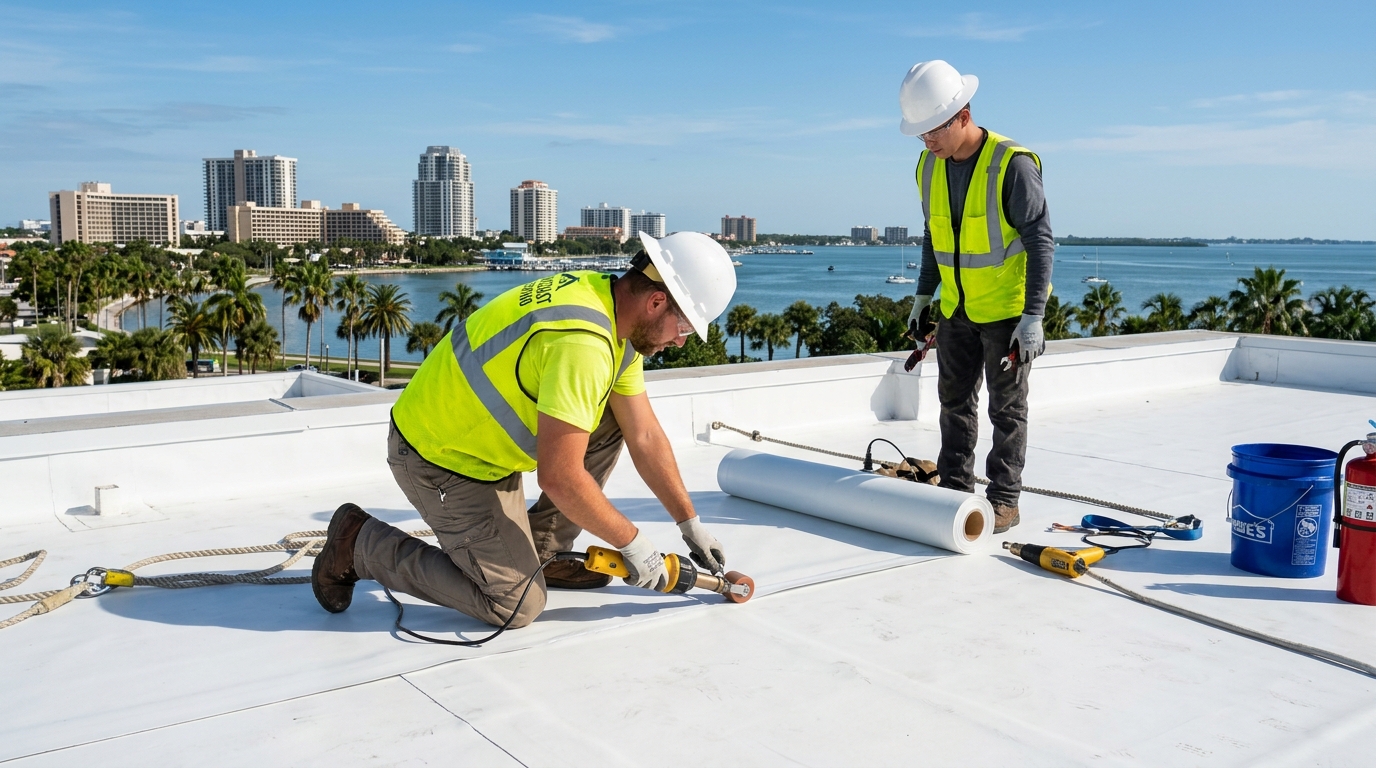
Commercial Flat Roof Ponding & Seam Split
Low-slope commercial or multi-family TPO, EPDM, or Mod-Bit membranes holding ponding snowmelt over 48 hours with seam delamination under sub-zero contraction.
1. Southeast Michigan Meteorological Dynamics & Severe Winter Stress
The Detroit metropolitan area and surrounding Wayne, Oakland, and Macomb counties occupy a meteorologically volatile corridor between Lake Huron, Lake Erie, and Lake St. Clair. During Michigan winters, polar vortex cold air masses plunge temperatures well below zero, freezing building materials into rigid states. This is punctuated by rapid warm-ups and heavy lake-effect snowfalls, producing extreme freeze-thaw cycles that severely stress residential and commercial roofing systems.
The primary failure mechanism across Metro Detroit rooflines during winter is the formation of massive eave ice dams. Heavy snow accumulation blankets the roof plane, acting as an insulating layer. Concurrently, uninsulated attic bypasses—including recessed lighting cans, bathroom exhaust ducts, and unsealed pull-down staircases—leak warm conditioned air into the unventilated attic space. This heat warms the underside of the upper roof deck, melting the snowpack. Meltwater trickles down the slope beneath the snow blanket until it reaches the cold, unheated eave overhangs and gutters.
At the freezing eave line, this water refreezes into a solid, growing ice barricade. As subsequent meltwater continues to drain down the roof, it becomes trapped behind the ice dam, creating a standing pool of hydrostatic water. Because standard asphalt shingles and cedar shakes are designed solely for gravity water-shedding rather than hydrostatic submersion, standing water backs up beneath overlapping shingle courses via capillary action. It bypasses conventional asphalt felt underlayment and infiltrates the wooden sheathing, rotting structural rafters, drenching blown-in cellulose insulation, and breaking through finished drywall ceilings.
Engineering Comparison 1: Waterproof Underlayments Under Severe Detroit Freeze-Thaw
Evaluating waterproof underlayment engineering standards under severe Southeast Michigan winter ice damming conditions:
2. Non-Destructive Moisture Diagnostics & FLIR Thermal Tracing
Diagnosing active water intrusion on Detroit's historic craftsman bungalows, multi-gabled Tudor estates in Birmingham, or commercial flat roofs in Troy requires scientific instrumentation rather than destructive guesswork. Water rarely travels straight down; it frequently enters at an exterior ridge, dormer, or chimney reglet, travels horizontally along rafter bays, and emerges 15 feet away through a drywall seam or ceiling electrical fixture.
To prevent destructive drywall demolition, on-call Detroit contractors dispatched through our network deploy advanced non-destructive diagnostic instruments:
- High-Resolution FLIR® Thermal Imaging: Detecting subtle infrared evaporative cooling signatures within insulated ceiling cavities. Wet fiberglass batts or saturated blown-in cellulose exhibit pronounced thermal emissivity differentials compared to adjacent dry structural lumber, displaying hidden moisture plumes on camera.
- Dielectric Capacitance Moisture Meters: Non-invasive radio-frequency probing that measures internal substrate moisture content up to 1 inch below ceiling plaster, drywall, or roofing membrane surfaces without puncturing the weather envelope.
- Optical Fiber Borescope Inspection: Micro-camera insertion through existing fixture collars to visually verify rafter rot, delaminated plywood sheathing, or biological mold growth inside enclosed joist cavities.
This diagnostic methodology ensures exact pinpointing of the water ingress source on the exterior roof plane while establishing an indisputable digital record for insurance claim validation.
Engineering Comparison 2: Architectural Shingle Wind Uplift & Cold Flexibility Standards
Comparing shingle mechanical performance under severe winter wind squalls off Lake Huron and Lake St. Clair:
3. Historic Detroit Brick Chimney & Parapet Flashing Methodology
Detroit possesses one of America's finest inventories of early 20th-century residential brick architecture. Neighborhoods like Palmer Woods, Boston-Edison, Indian Village, and historic suburbs such as Birmingham and Royal Oak feature massive brick and masonry chimneys, stone parapet copings, and intricate dormer intersections.
Over decades of extreme Michigan freeze-thaw cycles, moisture penetrates microscopic hairline cracks in aging lime-sand mortar joints. As water freezes, it expands by 9%, breaking mortar bonds and allowing chimney brickwork to shift. Furthermore, outdated single-piece tin or lead flashings nailed into mortar joints tear away under thermal movement. Untrained contractors often slather roofing tar or plastic roof cement over these joints. Within one season, the asphaltic cement dries, shrinks, and cracks, trapping moisture against the brick and funneling water down the chimney chase into interior fireplace flues and ceiling joists.
Our dispatched masonry and flashing specialists execute permanent two-piece reglet flashing restorations:
- Mortar Joint Grinding & Diamond Saw-Cut Reglet: Diamond blades grind out failed mortar along horizontal joints to a minimum depth of 1.25 inches.
- Individual Step Flashing Integration: 26-gauge galvanized steel or 16-oz cold-rolled copper step flashing pieces are woven under each successive shingle course, extending a minimum of 4 inches up the brick face.
- Two-Piece Counter-Flashing Installation: Factory-bent counter-flashing is inserted deep into the saw-cut reglet groove, mechanically fastened with lead expansion wedges, and hemmed at the bottom edge.
- Commercial Polyurethane Sealant Injection: Joint grooves are injected with ASTM C920 Class 50 polyurethane elastomeric sealant, creating a flexible, weather-tight joint that accommodates masonry thermal expansion without cracking.
4. Michigan State Building Codes & Contractor Licensing Compliance
All emergency roofing triage, temporary tarping, structural repairs, and permanent reroofing conducted through our referral dispatch network adhere strictly to the Michigan Residential Code (MRC Chapter 9), the Michigan Building Code (MBC Chapter 15), and local municipal codes enforced by the City of Detroit Buildings, Safety Engineering, and Environmental Department (BSEED).
Key regulatory standards strictly enforced on all network partner jobsites include:
- MRC R905.1.2 Ice Barrier Requirement: In Southeast Michigan, mandatory self-adhering polymer modified bitumen membrane (ASTM D1970) must extend from the eave's edge to a point at least 24 inches inside the exterior heated wall line.
- Decking Structural Soundness (R905.2.1): Shingles cannot be installed over deteriorated or springy wood decking. Compromised sheathing must be replaced with matching CDX exterior structural plywood or oriented strand board (OSB).
- Two-Layer Reroof Limitation (R908.3.1.1): Roof recovers are prohibited where an existing roof has two or more applications of any type of roof covering; complete tear-off down to structural sheathing is legally required.
- LARA Residential Builder Licensing: Dispatched contractors maintain verified, active licenses issued by the Michigan Department of Licensing and Regulatory Affairs (LARA), current Michigan Bureau of Workers' Disability Compensation coverage, and comprehensive general liability insurance of at least ,000,000.
Specialized Emergency Roofing Services Across Metro Detroit
Immediate 24/7 technical dispatch for residential and commercial property owners facing acute storm, ice, or flashing damage:
Emergency Roof Leak Repair
24/7 on-call dispatch for active ceiling leaks, drywall blistering, and sudden weather barrier punctures across Detroit and Wayne County.
Emergency Roof Tarping
Heavy-duty 10-mil woven poly tarping secured with 2x4 spruce framing battens screwed directly into rafters to resist 60+ mph winter gale gusts.
Hail & Storm Damage Inspection
Comprehensive digital scope-of-loss packets, FLIR thermal imaging, and test-square granule loss documentation for property insurance claims.
Chimney Brick Flashing Repair
Two-piece saw-cut counter-flashing reglet installations and polyurethane elastomeric joint resealing for historic Detroit brick chimneys and dormers.
Skylight & Pipe Boot Collar Repair
Replacement of split neoprene plumbing boots, cracked lead collars, and deteriorated skylight step flashings to stop interior ceiling water damage.
Flat Roof Ponding & Seam Repair
Molecular robotic hot-air seam welding for TPO/PVC and elastomeric cold mastic patching for modified bitumen and built-up commercial assemblies.
Serving Wayne, Oakland, and Macomb Counties
Connecting homeowners with local on-call roofing contractors staged across primary Southeast Michigan municipal hubs:
Active Ice Dam or Roof Leak Disaster in Metro Detroit?
Zero web forms, unmonitored email queues, or chatbot delays. Speak directly with a live emergency dispatch intake coordinator now:
CLICK TO CALL DISPATCH: (888) 208-4155